Ask
The facilitator poses a building question, never a discussion question. It points at something abstract, the kind of thing people usually talk around.
Build the thing that is slowing this team down.Everyday LSP takes the LEGO® Serious Play® Method, streamlines it, and makes it work in the conversations you are already having. Not a strategy offsite. The Tuesday morning stand up, the one to one, the class, the team meeting that always runs in circles.
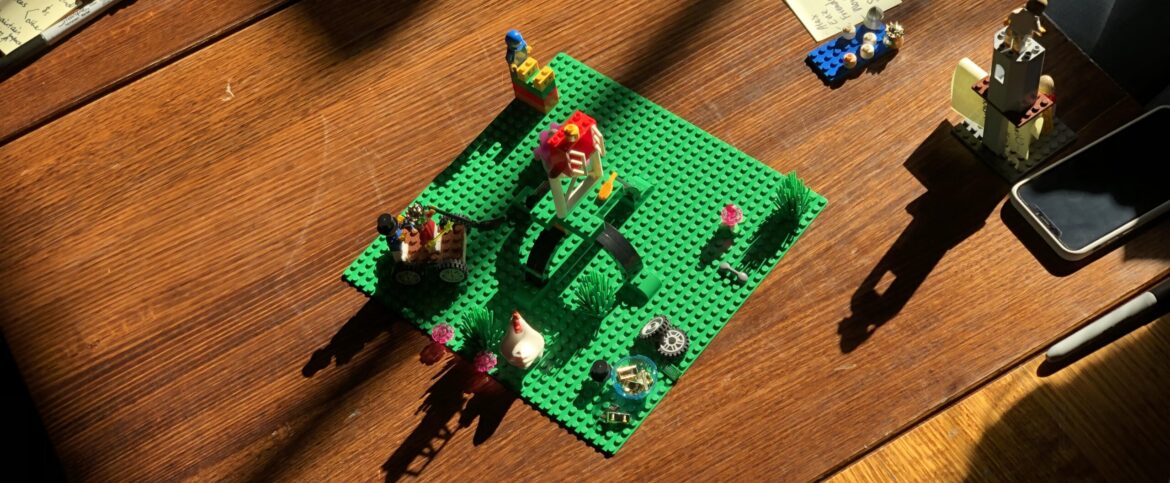
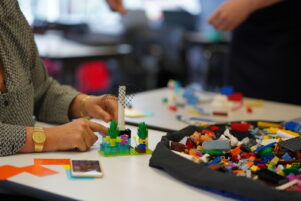
The full LEGO® Serious Play® Method is built for the big rooms. Strategy, organisational change, a whole day or two with a certified facilitator. It is brilliant, and most weeks you do not have it. Everyday LSP is the streamlined version, made for small groups and short conversations, so the method turns up in the meetings you already run.
This is the engine underneath every LEGO® Serious Play® session in the world, and it is the thing you will run over and over during the day. It looks almost too simple written down. What it does to a room is the part you have to feel.
The facilitator poses a building question, never a discussion question. It points at something abstract, the kind of thing people usually talk around.
Build the thing that is slowing this team down.Everybody builds. At the same time, in silence, hands moving before mouths do. A few minutes is usually all it takes. Nobody is watching anyone else's answer.
Every person in the room. No exceptions.Each person tells the story of what they built. The meaning lives in the model, so you ask about the model, never about the person. That small shift is why people say things they would not otherwise say.
Tell me about the grey piece at the back.The group looks at what turned up on the table together and pulls out what matters. Then one closing question turns the conversation into something that survives the meeting.
What did we just see that we keep missing?There are no right answers and no wrong models. That is not a nicety, it is the mechanism. Take away the possibility of being wrong and the quiet third of the room starts talking.
The full method carries a long list of techniques. Everyday LSP keeps the two that do the heavy lifting in a small group, and teaches you to read which one a conversation is asking for. Watch what happens on the second plate.
Everyone builds their own answer and everyone gets to tell its story. You surface four honest positions in the time a normal meeting spends on one loud one. This is where you go when you need to know what people actually think, before anyone has had the chance to agree with the boss.
Now the models come together and the group places them in relation to each other. Close means related. Far means disconnected. Suddenly you are not debating an abstract, you are pointing at a table. This is where a team stops talking past each other and starts seeing one picture.
That is the whole principle, in miniature. Give a person something to do with their hands and their thinking changes shape. They stop performing an opinion and start working one out.
In a meeting, the version of this is a room where every single person has built something, so every single person has something to say. Not because you called on them. Because there is a thing in front of them and it is theirs.
The streamlined Everyday LSP sequence, drilled until you can run it without notes and without a script in your hand.
Individual models and landscape models, and the judgement to know which one a conversation is asking you for.
The building question is where sessions are won or lost. You will write them, run them, watch them land badly, and fix them.
You bring your real meetings. You leave having rebuilt one of them into an Everyday LSP conversation you can run on Monday.
This is designed to sit inside your existing frameworks, not replace them. Retros, one to ones, lesson plans, coaching sessions, discovery.
One simple question at the end of a conversation that decides whether anything from it survives the walk back to the desk.
There is no facilitation career requirement here. The people who get the most out of this day are usually the ones who never planned to call themselves a facilitator at all.
Almost none of this is Michael talking. Every block on this tower is you, with bricks in your hands, running the thing. The teaching happens in the debrief after each one.
You will have built something and told a room about it inside twenty minutes. Everything explained afterwards makes sense because you already felt it happen.
The Everyday LSP sequence laid out properly, then run again with you holding it. Twice more before morning tea.
The first way of building. How to set it up, how long to give people, and what to do when someone tells you they are not creative.
Real food, real chairs, and the conversation where half the good questions of the day actually turn up.
The second way of building, and the one people remember. Individual models come together on one plate and the group arranges them into a shared picture.
You write building questions for your own work, run them on the room, and find out immediately which ones are vague. Then you fix them.
Take a meeting, class, retro or coaching session you already run and rebuild it as an Everyday LSP conversation, with Michael over your shoulder.
The question that makes it stick, then your kit, your book and your certificate before you leave the room.

Michael has spent more than fifteen years with this method, facilitating since 2013 and teaching it since 2014. He is the founder of Pivotal Play, he leads an international network of LSP trainers, and he has trained thousands of people around the world to run their own sessions.
He has run the method for teams at KPMG, Ernst & Young, Google and the innovation team at the LEGO Group. He wrote the books, built the certification programme, started the community and hosts the podcast.
Everyday LSP came out of a question he kept getting asked. People loved the method, then went back to work and never found a two day workshop to use it in. So he took it apart and rebuilt a version that fits an ordinary week. He teaches this day himself.
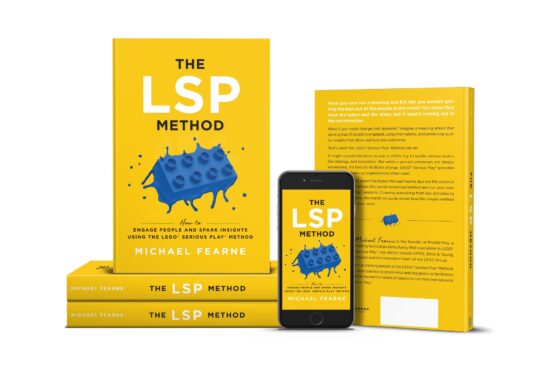
The LSP Method is the full one. Every activity and step for running proper sessions, from individual models through shared and landscape models. It is where a lot of facilitators started.
Everyday LSP is the streamlined companion this workshop is built on. Your seat includes a copy, so the day has something to keep pointing back to.
Book the day, get the book“The LEGO Serious Play method enables higher level creative thinking and better communication.
KristianConsultant
“The way people described what they built was quite powerful and felt very compelling.
KrisHead of Innovation
“I would recommend this for anyone seeking to enhance facilitation skills with something to push comfort zones.
StephFacilitator
Everyday LSP is built for small group conversations, so it is taught in one. Everybody builds every round and everybody gets their model talked about properly, which stops being true the moment the room gets big.
Nothing near you yet? Tell us your city and Michael will put it on the list.
USD per seat. No upsell at the back of the room and no module you have to buy later to make the first one work.
Pick your dateNone at all. Everyday LSP assumes no previous experience with the method. You will have built your first model and told a room about it before the first break, which is the fastest way anyone has found to explain what this is.
The full method is built for the bigger, longer work. Strategy, organisational change, a whole day or two with a certified facilitator running a large group. Everyday LSP is streamlined for daily conversations and small groups. Same engine, different vehicle, and it fits in a week where nobody has cleared two days.
It is designed to do the opposite. Everyday LSP is meant to complement how you already work, not replace it. People take it back into retros, one to ones, lesson plans, coaching sessions and discovery workshops, and the afternoon of the day is spent doing exactly that with your own material.
Michael Fearne, every time. He is the author of The LSP Method and Everyday LSP, he has been facilitating since 2013 and teaching since 2014, and he has trained thousands of people around the world. You are not getting a licensed reseller reading his slides.
Bring one real situation. A meeting that keeps going in circles, a class that has gone flat, a team that is not saying what it thinks. Everything else, including your bricks, is on the table when you arrive.
Yes, and it is often where it lands hardest, because everyone walks out with a shared language for the same problem. Tell us the team and the challenge and we will come back with a shape.
One day, a small group, and a method that has been changing rooms since 2013. You will leave with your own meeting rebuilt, a kit in your bag and a certificate in your hand.
Concept preview. Everyday LSP, the one day format, the six learning outcomes, the audience list, the FAQ answers, the trainer bio and the workshop cities are real and drawn from lspmethod.com. The $997 USD price, the run sheet times, the seat counts and the exact inclusions are illustrative content created for this concept.